
Keys
How Bitcoin P2PKH Addresses Are Derived
A Bitcoin P2PKH address is derived from a secp256k1 public key, a public-key hash, a mainnet version byte and a Base58Check encoding.
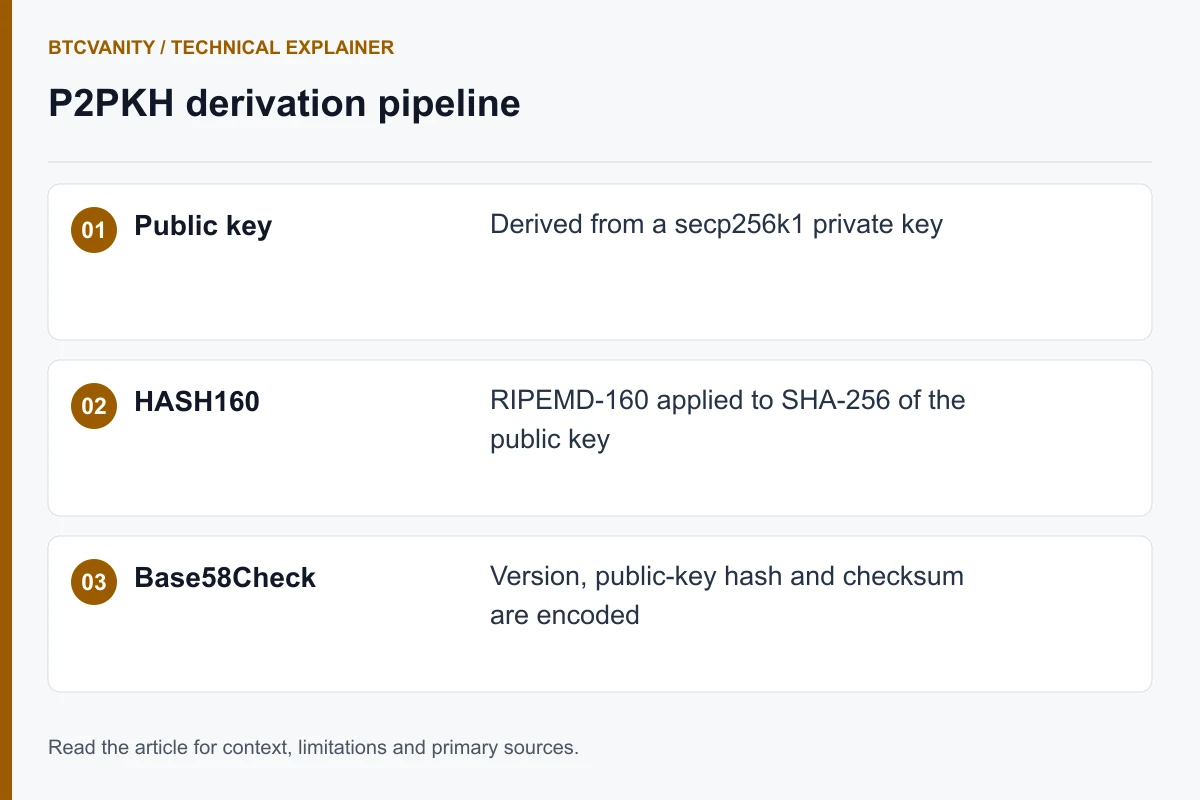
From a secret scalar to a receiving address
The worker uses a private scalar to derive a secp256k1 public key. For its compressed P2PKH output, it hashes the serialized public key with SHA-256 and then RIPEMD-160. A mainnet version byte and a checksum are included before Base58 encoding.
Each stage has a different role: the secret enables signing, the public key is derived from it, the hash identifies the P2PKH spending condition, and the encoding makes the destination transferable as text.
Where vanity search enters the process
The desired text is checked after address derivation. It does not allow the service to pick arbitrary address characters and solve backwards for a key. Instead, candidate keys are tried until their derived addresses meet the pattern.
This is why adding characters increases search difficulty. The generator changes the candidate key, not the address by hand.
What the independent check establishes
Before reporting success, the worker decodes the WIF output, derives its public key and address independently, and compares the address and requested pattern. A malformed WIF, mismatched address or nonmatching pattern is rejected.
That check establishes consistency of the returned pair. It does not audit every aspect of the random source or hosting system; see the separate security questions. Save the exact WIF because the public address alone cannot restore that secret.
Explore the related mechanism
- Bitcoin Vanity Address Patterns: Prefix, Suffix and Base58 — This generator returns Bitcoin mainnet legacy P2PKH addresses beginning with 1. Patterns use Base58, which excludes 0, O, I and lowercase l.
- Bitcoin Vanity Generators: Local Tools, Hosted Search and Keys — A memorable address is useful only if its private key is unpredictable. A successful pattern match does not establish the quality of a random-number source.
- Open the complete workflow guide to place these checks in order.
- Open the address generator when you have chosen a compatible format and pattern.
Sources and editorial method
The technical references below support the concepts discussed in this article. Examples and comparison worksheets are explanatory, not measured service benchmarks.
Read next
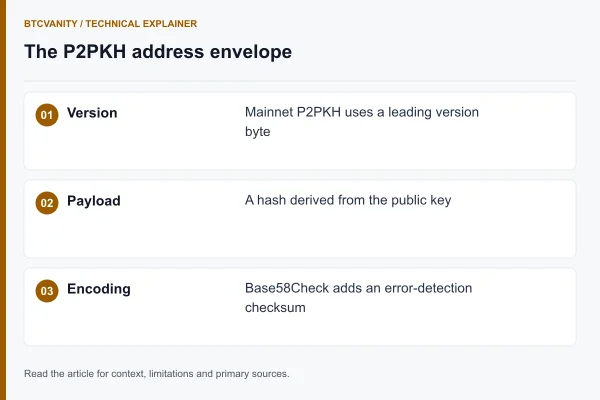
Address format3 min read
Bitcoin Vanity Address Patterns: Prefix, Suffix and Base58
Choose a valid Bitcoin vanity prefix or suffix with worked examples. Learn why P2PKH starts with 1 and why a pattern cannot turn it into bc1.
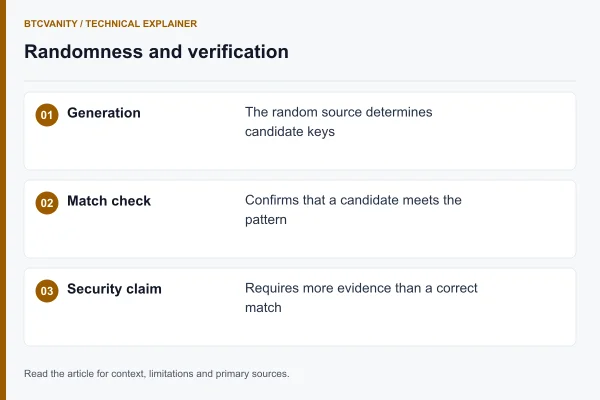
Security4 min read
Bitcoin Vanity Generators: Local Tools, Hosted Search and Keys
Compare a local Bitcoin vanity generator with hosted search. Separate key-address validation, randomness, custody and wallet compatibility.
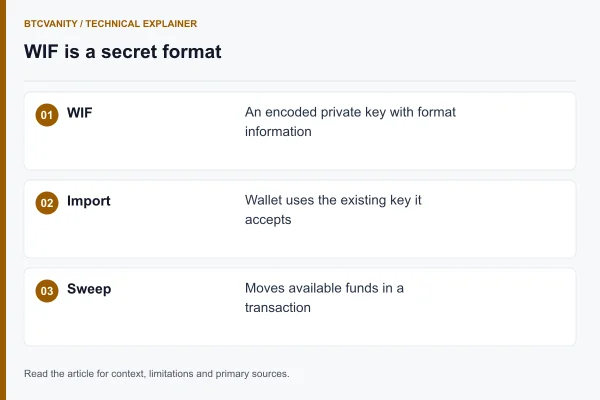
Wallets2 min read
Importing a Bitcoin Vanity WIF into a Wallet
The result contains a Wallet Import Format private key. Use a wallet that explicitly supports the returned key and legacy P2PKH addresses.
Address format2 min read
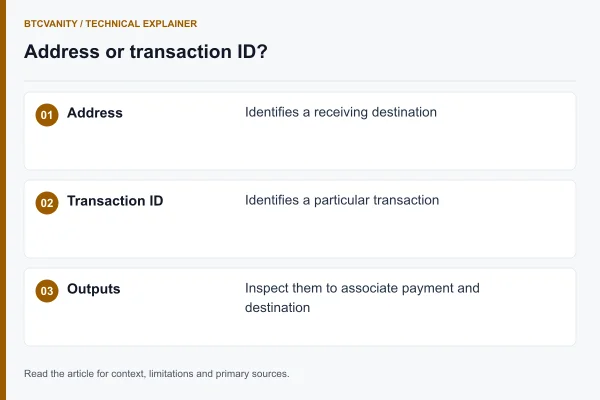
Bitcoin Address or Transaction ID: How to Tell Them Apart
A receiving address and a transaction identifier describe different things. The result of this generator is an address and its private key, not a transaction.