
Address format
Bitcoin Vanity Address Patterns: Prefix, Suffix and Base58
Choose a valid Bitcoin vanity prefix or suffix with worked examples. Learn why P2PKH starts with 1 and why a pattern cannot turn it into bc1.
What the characters mean
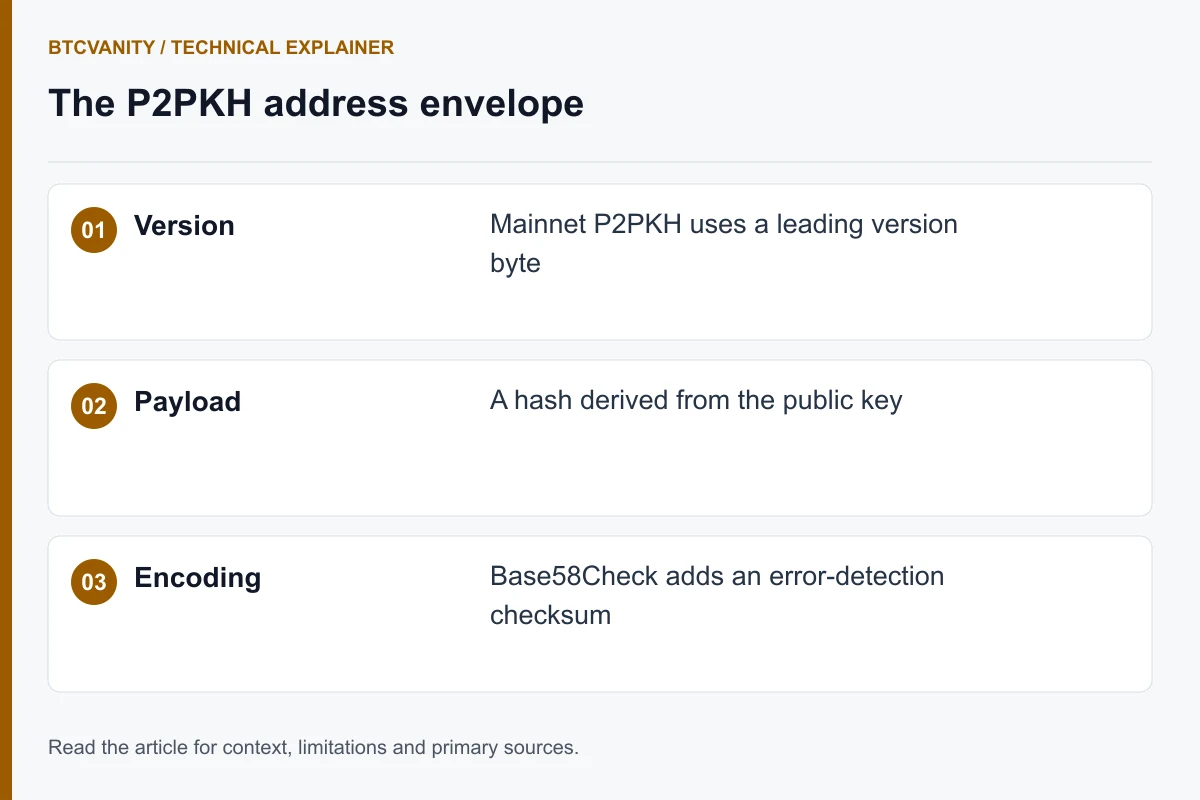
BTCVanity searches legacy mainnet addresses whose first character is 1. The visible pattern is selected by trying keys; it is not a label appended to an existing wallet. A checksum is encoded into the result to catch many transcription errors. It does not identify the recipient.
The accepted alphabet is 123456789ABCDEFGHJKLMNPQRSTUVWXYZabcdefghijkmnopqrstuvwxyz. Zero, uppercase O, uppercase I and lowercase l are absent. A word containing those characters must be changed before searching.
Prefix, suffix and the fixed marker
For a prefix, the worker adds the required 1 when your input does not already begin with it. A suffix is matched at the end of the full encoded address. Use one mode at a time; this interface accepts at most eight input characters.
Case-insensitive matching changes which candidates are accepted. It does not permit changing the capitalization of the address after generation. Copy the returned string exactly.
Choose a format before searching
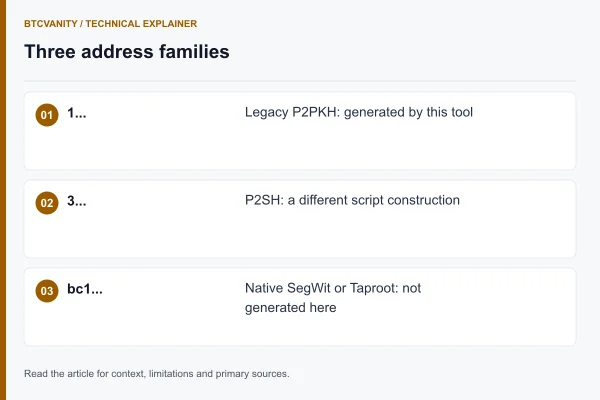
If your requirement is a bc1 address, this generator is not the right format. Read the P2PKH, SegWit and Taproot comparison before selecting a pattern.
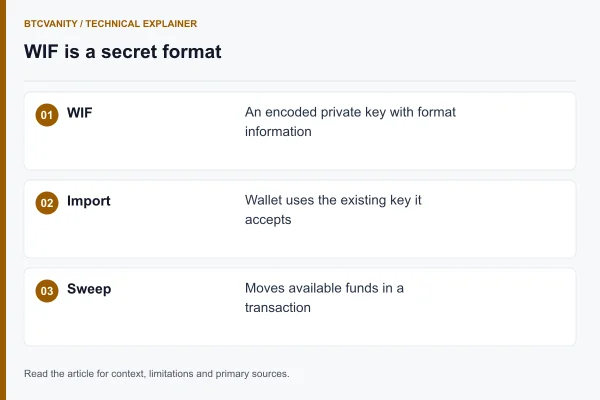
A successful result includes a WIF private key. The wallet import guide explains why a receiving address and its key must be handled separately.
Worked prefix and suffix examples
The entries below are search inputs, not addresses you can receive payments with. In prefix mode, this worker supplies the leading 1 if it is absent; suffix mode checks the end of the complete address.
| Input and mode | Requested match | What to check |
|---|---|---|
| BTC, prefix | 1BTC… with exact case enabled | The 1 is the mainnet P2PKH marker; BTC is the chosen fragment. |
| 1BTC, prefix | 1BTC… with exact case enabled | Do not add a second 1 unless that second character is intentional. |
| 777, suffix | …777 | Digits have no upper/lower-case alternatives. |
| moon, prefix | 1moon… with exact case enabled | Uppercase O is unavailable, while lowercase o is allowed. |
| COOL, either mode | Invalid input | Uppercase O is absent from Base58; choose another spelling. |
What case-insensitive matching really changes
For a valid input such as BTC, a case-insensitive search accepts the available uppercase and lowercase versions of those letters. A numeric suffix such as 777 receives no benefit from this option. Some Base58 letters have only one allowed case, so a single reduced alphabet size is not an exact model for every pattern.
Once found, preserve the address exactly as returned. Changing a letter afterward creates a different string and can break the checksum. Read the difficulty guide before extending a pattern.
Move from a fragment to a complete address
Use the Bitcoin vanity address generator after checking the format and alphabet. Choose one mode, start with a short fragment and keep an easier alternative. After a match, follow the WIF import checklist to compare the complete wallet-derived address.
Explore the related mechanism
- Bitcoin P2PKH, SegWit and Taproot Addresses — The current worker generates legacy P2PKH addresses. It does not generate bc1 SegWit or Taproot addresses.
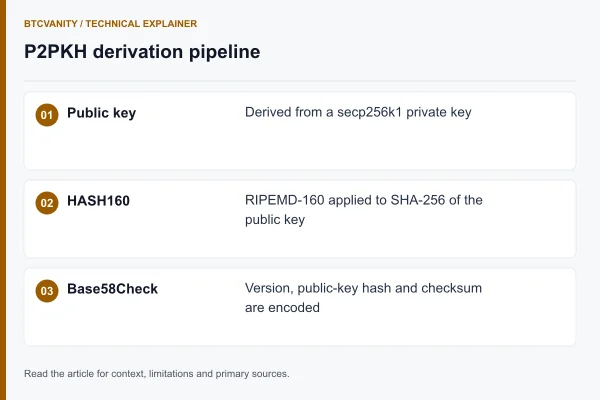
- How Bitcoin P2PKH Addresses Are Derived — A Bitcoin P2PKH address is derived from a secp256k1 public key, a public-key hash, a mainnet version byte and a Base58Check encoding.
- Open the complete workflow guide to place these checks in order.
- Open the address generator when you have chosen a compatible format and pattern.
Frequently asked questions
Should I type the leading 1 in a Bitcoin vanity prefix?
This worker accepts a prefix with or without its initial 1 and supplies the marker when it is absent. An additional 1 after the marker is part of your requested pattern.
Can I use the same pattern to generate a bc1 address?
Not with this service. Its output is legacy P2PKH. Native SegWit and Taproot need their own address encoding and a generator supporting the intended format.
Sources and editorial method
The technical references below support the concepts discussed in this article. Examples and comparison worksheets are explanatory, not measured service benchmarks.
Read next
Address format2 min read
Bitcoin P2PKH, SegWit and Taproot Addresses
The current worker generates legacy P2PKH addresses. It does not generate bc1 SegWit or Taproot addresses.
Keys2 min read
How Bitcoin P2PKH Addresses Are Derived
A Bitcoin P2PKH address is derived from a secp256k1 public key, a public-key hash, a mainnet version byte and a Base58Check encoding.
Wallets2 min read
Importing a Bitcoin Vanity WIF into a Wallet
The result contains a Wallet Import Format private key. Use a wallet that explicitly supports the returned key and legacy P2PKH addresses.
Address format2 min read
Bitcoin Address or Transaction ID: How to Tell Them Apart
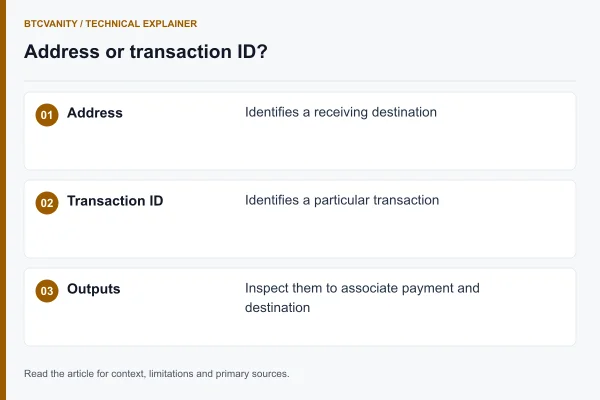
A receiving address and a transaction identifier describe different things. The result of this generator is an address and its private key, not a transaction.