
Security
Bitcoin Vanity Generators: Local Tools, Hosted Search and Keys
Compare a local Bitcoin vanity generator with hosted search. Separate key-address validation, randomness, custody and wallet compatibility.
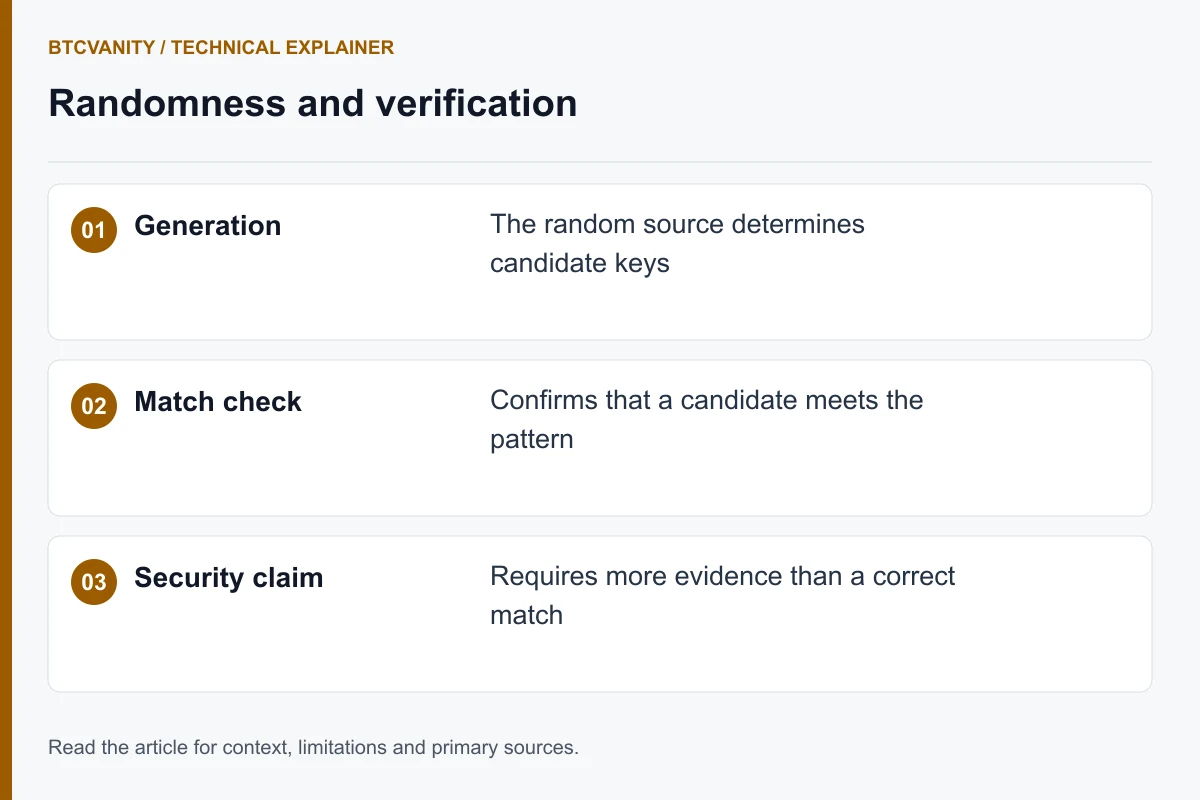
Correct output and unpredictable keys are different checks
Result verification answers whether a private key derives the returned address and whether that address matches the requested pattern. It cannot prove that nobody else has seen the key. Nor does one valid result prove that an engine draws secrets from a sufficiently large, unpredictable space.
A search engine can produce mathematically valid addresses while having a flawed random source. Faster generation does not compensate for predictable candidate keys.
What using this service requires you to trust
BTCVanity runs the search on a server-side RunPod worker. The secret exists in that execution environment and travels through the service to your browser. This is not local-only generation, and it is not a split-key protocol.
The broker avoids saving private keys in its public job database or operational notifications. That limited storage policy must not be read as proof that a provider or compromised runtime could never access a result.
Choose the trust model before the pattern
For a use case that requires exclusive local creation of keys, use an appropriately reviewed local wallet or tool. Do not treat a vanity service as a hardware-wallet substitute. Read the import and backup guide before deciding whether an exported WIF fits your workflow.
Keep the claims separate: valid address, matching pattern, private-key backup, entropy quality and hosting security each require different evidence. The derivation guide explains the first of those checks.
Local tools and hosted generators: different responsibilities
A search for “vanity search” can refer to the general process or to the independent VanitySearch project. JeanLucPons/VanitySearch describes itself as a Bitcoin address prefix finder with CPU/GPU features. Its documented capabilities must not be assumed to be features of this website.
| Workflow | Who operates the search | What you must establish |
|---|---|---|
| Local command-line tool | You, on your own machine | Source/version, supported format, randomness, output handling and backups. |
| Hosted web generator such as BTCVanity | The service and its compute provider | Whether remote key creation fits your requirements, plus result and wallet checks. |
| Wallet-generated receiving address | Your wallet workflow | Address type and recovery procedure; a chosen vanity fragment may not be supported. |
Evidence to look for before comparing speed
Ask for the exact program version, address type, pattern, case mode and hardware alongside any benchmark. A rate measured on one format or one device cannot establish the wait for another configuration. Distinguish measured throughput from simulated counters.
For an offline requirement, review the complete workflow, including loading the software and handling its output. For this hosted service, assume the generation environment can access the key. No badge, checksum or successful import turns that into exclusive local generation.
Choose a compatible workflow, then a pattern
Review address formats and WIF import before choosing the tool. If hosted P2PKH generation fits the requirement, the BTCVanity generator accepts a prefix or suffix. If local key creation is required, choose a separately reviewed local workflow instead.
Explore the related mechanism
- How Bitcoin P2PKH Addresses Are Derived — A Bitcoin P2PKH address is derived from a secp256k1 public key, a public-key hash, a mainnet version byte and a Base58Check encoding.
- Bitcoin Vanity Search Difficulty: Attempts, Odds and Time — Every extra fixed character narrows the set of matches. Search duration is random and depends on both the pattern and available hardware.
- Open the complete workflow guide to place these checks in order.
- Open the address generator when you have chosen a compatible format and pattern.
Frequently asked questions
Is BTCVanity the VanitySearch project?
No. VanitySearch is a separate open-source Bitcoin prefix-finder project. A generic vanity search describes the task; it does not identify the software or its operator.
Does a correct WIF-to-address match prove the generator is secure?
It verifies the relationship between the two values. It does not establish the quality of randomness or prove that no operator or other system could access the key.
Sources and editorial method
The technical references below support the concepts discussed in this article. Examples and comparison worksheets are explanatory, not measured service benchmarks.
Read next
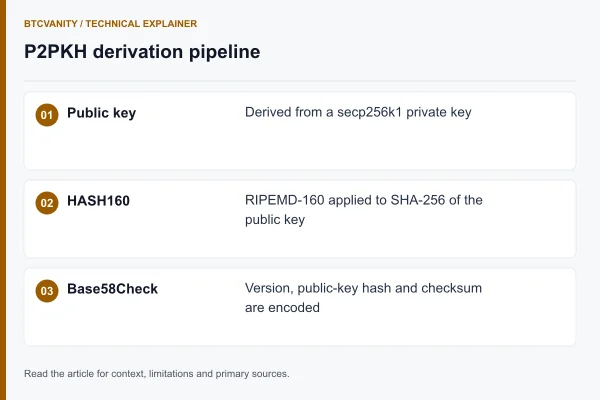
Keys2 min read
How Bitcoin P2PKH Addresses Are Derived
A Bitcoin P2PKH address is derived from a secp256k1 public key, a public-key hash, a mainnet version byte and a Base58Check encoding.
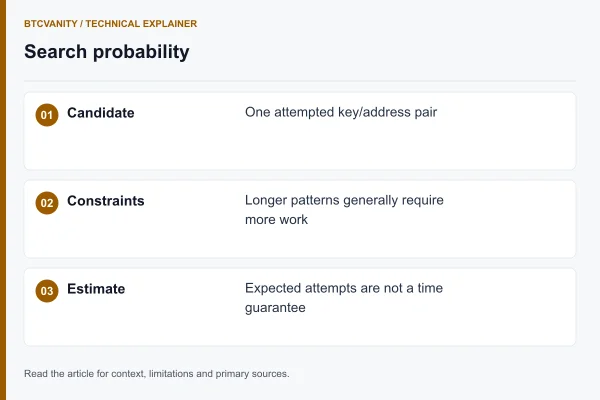
Generation4 min read
Bitcoin Vanity Search Difficulty: Attempts, Odds and Time
Understand Bitcoin vanity search time with a worked probability table. Compare pattern length, case rules, startup delay and practical stop conditions.
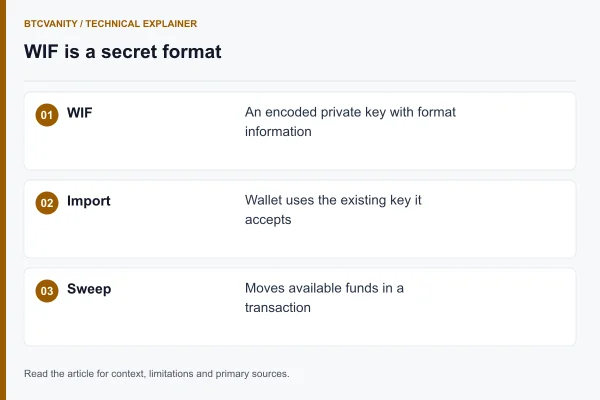
Wallets2 min read
Importing a Bitcoin Vanity WIF into a Wallet
The result contains a Wallet Import Format private key. Use a wallet that explicitly supports the returned key and legacy P2PKH addresses.
Security2 min read
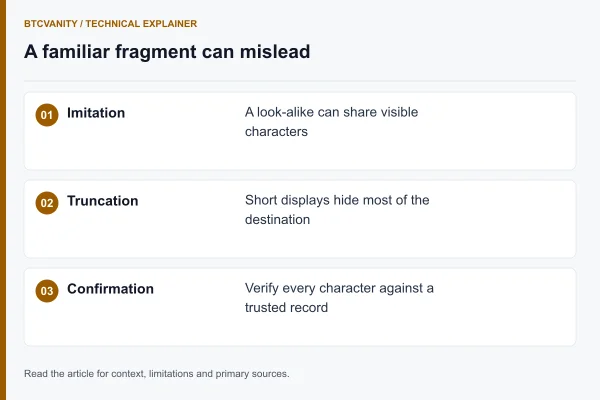
Bitcoin Address Poisoning: Look-Alike Addresses
An attacker can create a different address sharing a familiar prefix or suffix. Those matching characters are not evidence of ownership.