
Wallets
Importing a Bitcoin Vanity WIF into a Wallet
The result contains a Wallet Import Format private key. Use a wallet that explicitly supports the returned key and legacy P2PKH addresses.
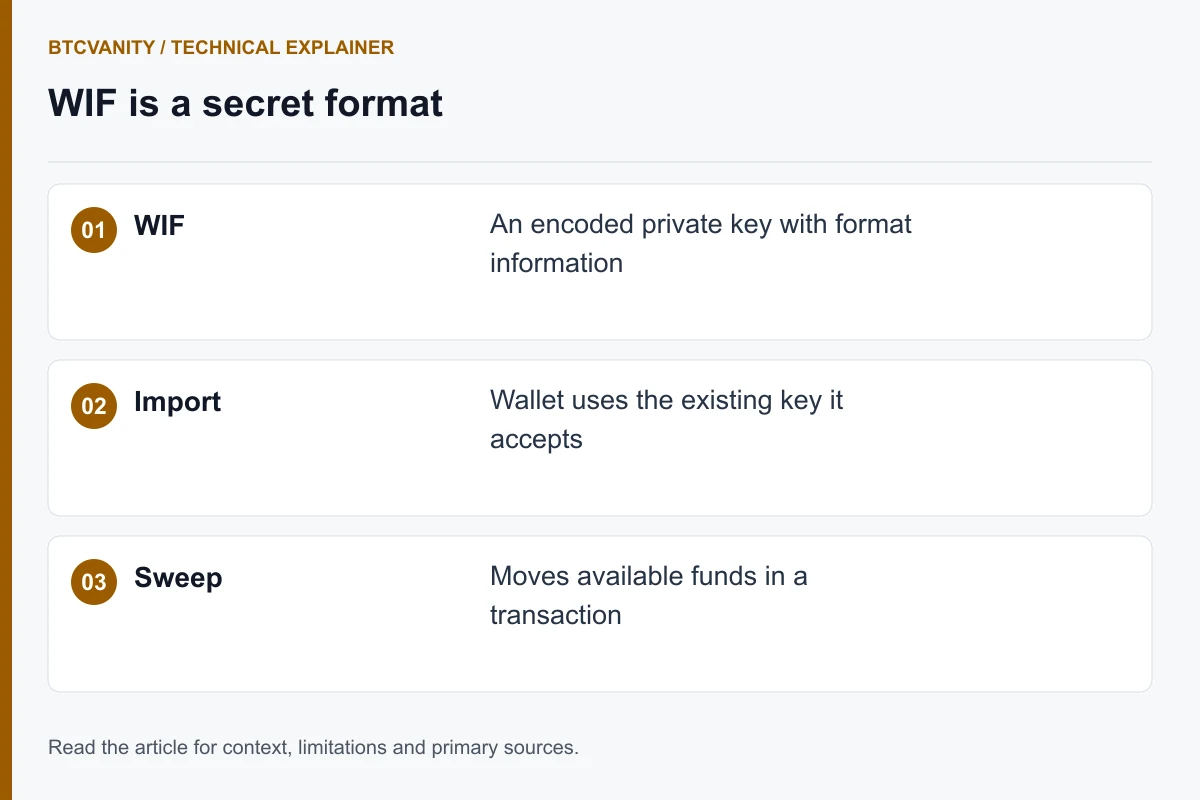
Check support before entering the key
BTCVanity returns a Wallet Import Format key for a legacy P2PKH result. Confirm that your chosen wallet supports importing that format and that address type. A field asking for a seed phrase, transaction ID or watch-only address is not the private-key import field.
Use the wallet’s own documentation for its current flow. This guide does not claim that every wallet, exchange or hardware device accepts exported WIF keys.
Import and sweep do different things
Import makes the existing key available to the wallet, subject to that wallet’s behavior. Sweeping generally creates a transaction moving available funds to a destination in another wallet. A sweep is an on-chain action with its own fee; it does not preserve the old vanity address as the new destination.
Before an import is used for receiving, check that the wallet derives the same complete P2PKH address. A different address can indicate a different script or public-key interpretation. Do not assume that a successful dialog alone proves a match.
Do not assume your old seed backs up an imported key
A separately generated key is not automatically part of a seed phrase created before the import. Follow the wallet’s backup documentation and preserve the exact WIF securely. Public receiving instructions must never contain it.
Hosted generation means the secret was created on the service infrastructure. Read the trust model before choosing this workflow. The network guide explains why the network belongs in your verification checklist.
Explore the related mechanism
- How Bitcoin P2PKH Addresses Are Derived — A Bitcoin P2PKH address is derived from a secp256k1 public key, a public-key hash, a mainnet version byte and a Base58Check encoding.
- Bitcoin P2PKH, SegWit and Taproot Addresses — The current worker generates legacy P2PKH addresses. It does not generate bc1 SegWit or Taproot addresses.
- Open the complete workflow guide to place these checks in order.
- Open the address generator when you have chosen a compatible format and pattern.
Sources and editorial method
The technical references below support the concepts discussed in this article. Examples and comparison worksheets are explanatory, not measured service benchmarks.
Read next
Keys2 min read
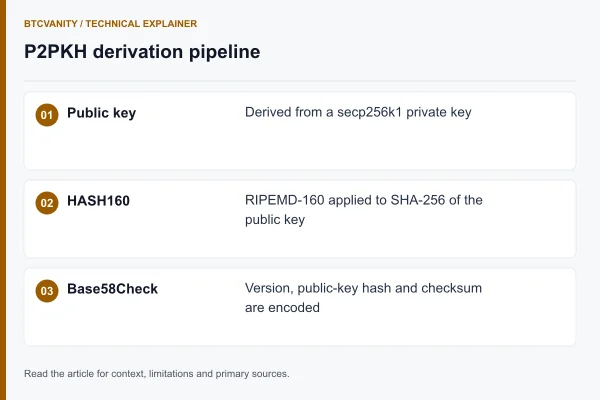
How Bitcoin P2PKH Addresses Are Derived
A Bitcoin P2PKH address is derived from a secp256k1 public key, a public-key hash, a mainnet version byte and a Base58Check encoding.
Address format2 min read
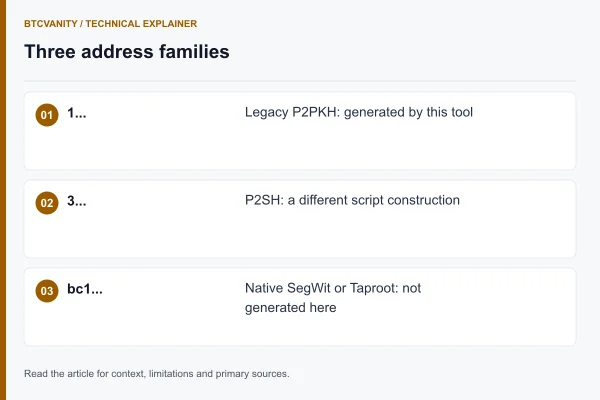
Bitcoin P2PKH, SegWit and Taproot Addresses
The current worker generates legacy P2PKH addresses. It does not generate bc1 SegWit or Taproot addresses.
Security4 min read
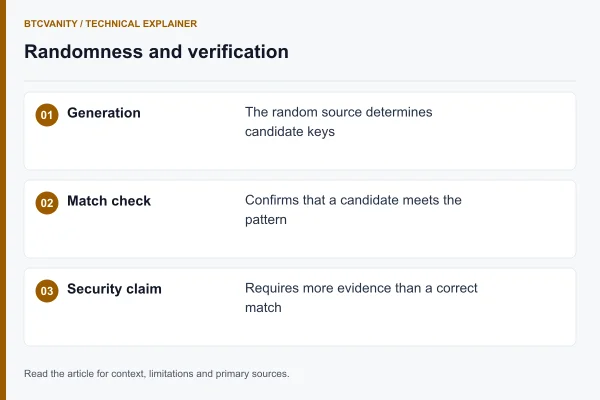
Bitcoin Vanity Generators: Local Tools, Hosted Search and Keys
Compare a local Bitcoin vanity generator with hosted search. Separate key-address validation, randomness, custody and wallet compatibility.
Address format2 min read
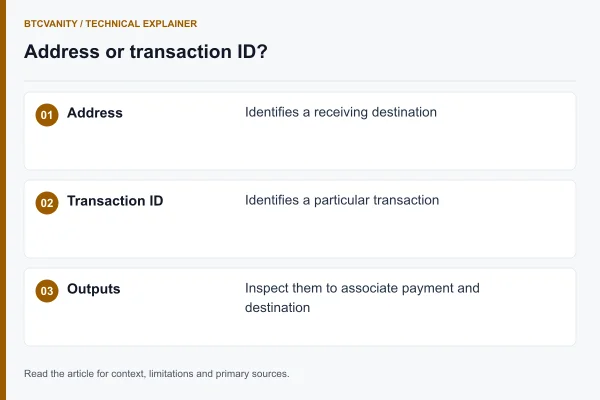
Bitcoin Address or Transaction ID: How to Tell Them Apart
A receiving address and a transaction identifier describe different things. The result of this generator is an address and its private key, not a transaction.