
Address format
Bitcoin Address or Transaction ID: How to Tell Them Apart
A receiving address and a transaction identifier describe different things. The result of this generator is an address and its private key, not a transaction.
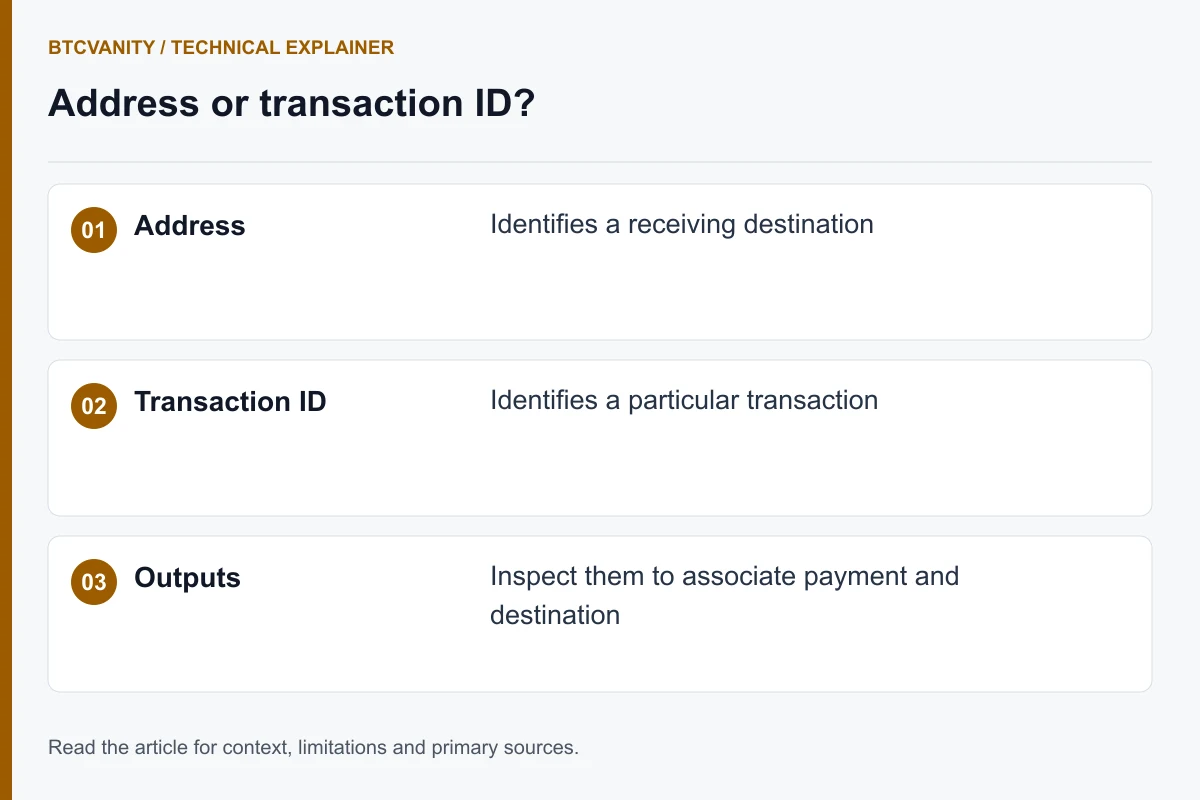
Identify the object before looking it up
A receiving address specifies where a payment can be sent. A transaction ID identifies a particular transaction. A private key authorizes spending under the relevant conditions. These are different objects even when a wallet or explorer displays them close together.
| Object | Purpose | Safe to place in an explorer? |
|---|---|---|
| Public address | Receiving destination and public history lookup | Yes, with public-history privacy implications |
| Transaction ID | Identify a submitted transaction | Yes |
| Private key / WIF | Authorize spending | No |
Why a new result may have no history
Address generation performs a key search. It does not mine coins, activate a Bitcoin balance, broadcast a transfer or produce a transaction receipt. An unused address can therefore be a valid result even when an explorer shows no activity.
If you are tracking a payment, ask for the transaction ID from the sending wallet and check the correct network. The generator’s job ID is only an application identifier; it is not a blockchain transaction ID.
Explore the related mechanism
- Bitcoin Address Poisoning: Look-Alike Addresses — An attacker can create a different address sharing a familiar prefix or suffix. Those matching characters are not evidence of ownership.
- Do Bitcoin Vanity Addresses Change Transaction Fees? — A recognizable pattern does not itself provide a transaction-fee discount. Fees depend on the transaction and spending conditions.
- Open the complete workflow guide to place these checks in order.
- Open the address generator when you have chosen a compatible format and pattern.
Sources and editorial method
The technical references below support the concepts discussed in this article. Examples and comparison worksheets are explanatory, not measured service benchmarks.
Read next
Security2 min read
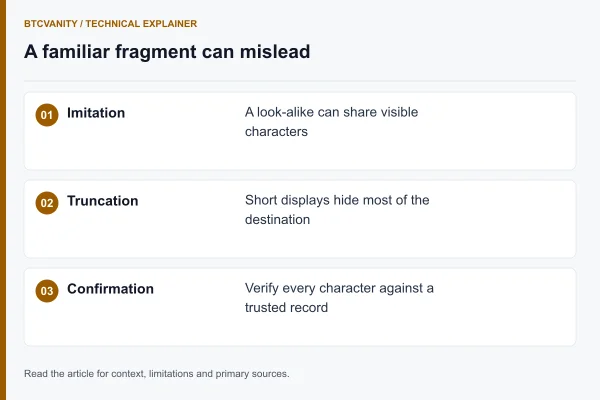
Bitcoin Address Poisoning: Look-Alike Addresses
An attacker can create a different address sharing a familiar prefix or suffix. Those matching characters are not evidence of ownership.
Transactions2 min read
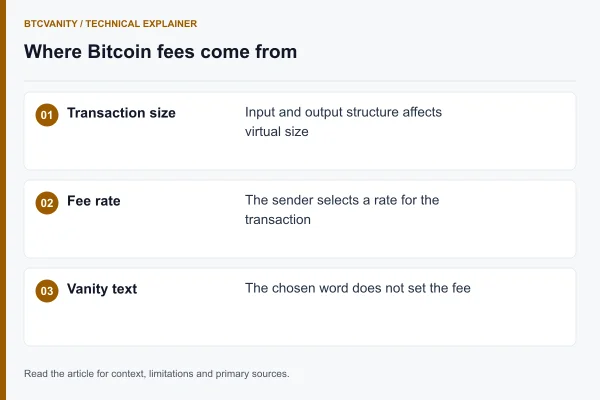
Do Bitcoin Vanity Addresses Change Transaction Fees?
A recognizable pattern does not itself provide a transaction-fee discount. Fees depend on the transaction and spending conditions.
Networks2 min read
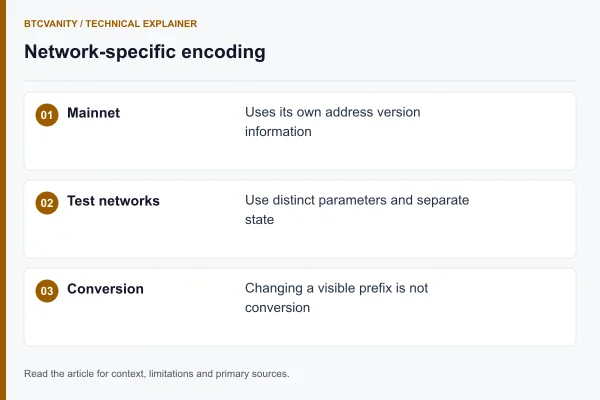
Bitcoin Mainnet and Test Networks: Keep Addresses Separate
This service generates Bitcoin mainnet P2PKH addresses. A result is not a testnet address merely because you intend to use it for testing.
Address format2 min read
Bitcoin P2PKH, SegWit and Taproot Addresses
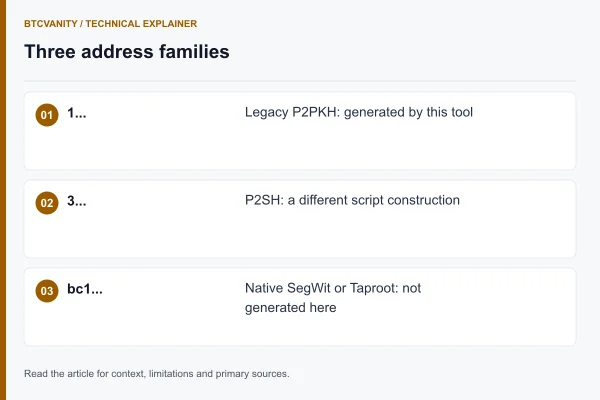
The current worker generates legacy P2PKH addresses. It does not generate bc1 SegWit or Taproot addresses.