
Generation
Bitcoin Vanity Search Difficulty: Attempts, Odds and Time
Understand Bitcoin vanity search time with a worked probability table. Compare pattern length, case rules, startup delay and practical stop conditions.
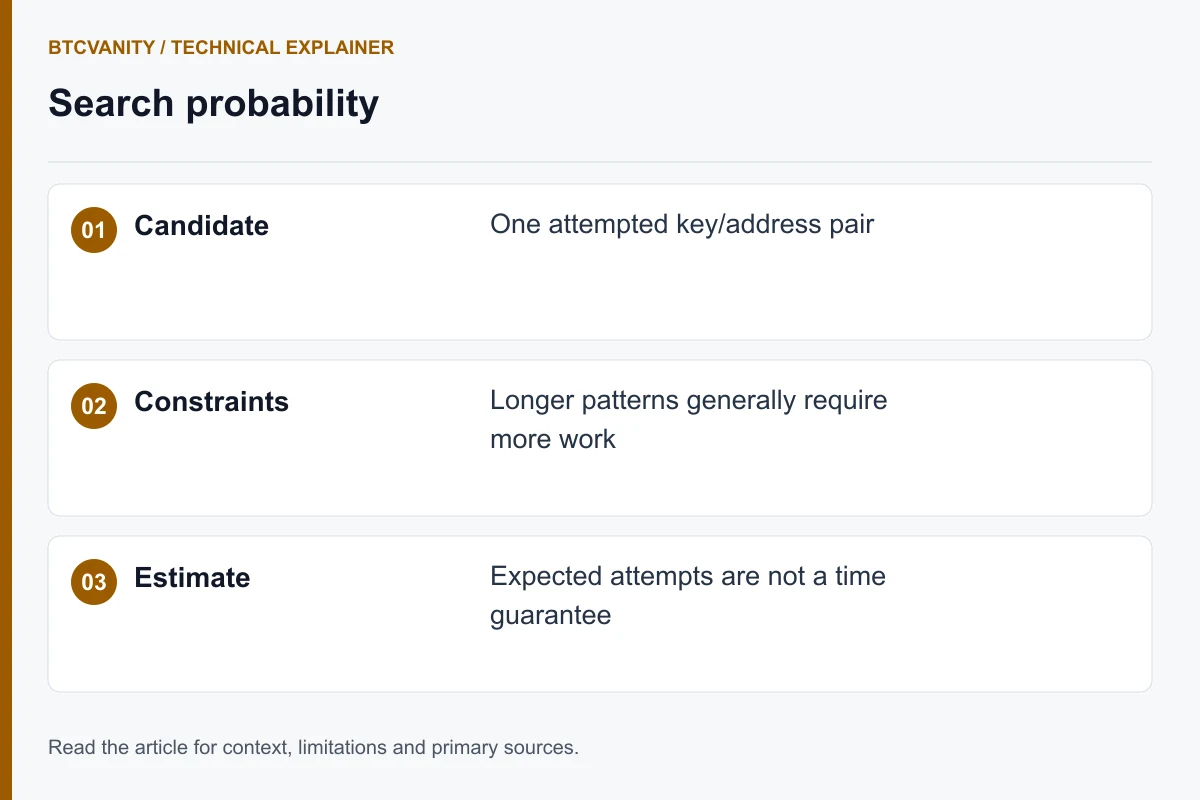
The useful approximation and its limits
For equally likely independent Base58 positions, fixing n characters would leave roughly one match in 58^n candidates. That is an explanatory model, not a performance measurement of this service. Leading version bytes, address length, checksum encoding and case variants affect the actual distribution.
The mandatory 1 is already part of a Bitcoin mainnet P2PKH address. It must not be counted as an independently chosen vanity character. Two patterns with the same visible length need not have identical prefix probabilities.
An average is not a deadline
Even if the match probability p and checking rate r were known, 1/(p × r) would be an average search duration under a simplified model. A particular job could finish early or run longer. Queueing and worker startup add time that is not represented by candidate throughput.
A terminal animation is not a measured hash rate. This site does not publish a guaranteed time for a pattern or a benchmark for every GPU configuration.
Make the first search easy to evaluate
Start with a short prefix or suffix. If exact capitalization is unimportant, allow case variants. If the search takes longer than you want, request cancellation and wait for its status before starting another.
Use the character and format guide to distinguish invalid input from a difficult search. For what a verified result proves, read the key-generation security explanation.
A worked model: what another character costs
For illustration only, suppose each constrained character were independent and uniformly distributed over 58 symbols, and every letter had to match its case. Then the expected number of candidates would be 58 to the power of the chosen character count. This is a toy model, especially for prefixes: it is not an exact difficulty table for Bitcoin addresses or a speed claim for this service.
| Chosen characters | Expected candidates in the toy model | Relative to the preceding row |
|---|---|---|
| 2 | 3,364 | — |
| 3 | 195,112 | 58 times as many |
| 4 | 11,316,496 | 58 times as many |
| 5 | 656,356,768 | 58 times as many |
Why an estimated average is not a countdown
If each independent candidate has match probability p, the chance of at least one match after N attempts is 1 − (1 − p)^N. For a small p, checking about 1/p candidates gives roughly a 63% success chance, not 100%. Roughly three times that many attempts gives about a 95% chance under the same assumptions.
These percentages explain a random search; they are not live job telemetry. A reliable time calculation also needs the actual matching rules and a measured candidate rate. Queueing and worker startup belong outside that rate.
What to change when a search takes too long
First confirm that the input is valid using prefix and suffix examples. Then shorten the fragment or relax letter case if its appearance allows it. Repeating an unchanged search does not make its next candidates inherently luckier.
If you decide to stop, request cancellation and wait for confirmation before submitting another job. Return to the Bitcoin generator with your shorter fallback rather than interpreting a timeout as proof that a valid pattern can never occur.
Explore the related mechanism
- Bitcoin Vanity Address Patterns: Prefix, Suffix and Base58 — This generator returns Bitcoin mainnet legacy P2PKH addresses beginning with 1. Patterns use Base58, which excludes 0, O, I and lowercase l.
- Bitcoin Vanity Generators: Local Tools, Hosted Search and Keys — A memorable address is useful only if its private key is unpredictable. A successful pattern match does not establish the quality of a random-number source.
- Open the complete workflow guide to place these checks in order.
- Open the address generator when you have chosen a compatible format and pattern.
Frequently asked questions
Does a five-character Bitcoin pattern always take the same time?
No. Even the same pattern can finish at different times. Prefix constraints, case rules, hardware and random variation all matter.
Does case-insensitive mode make numeric patterns faster?
No. Digits have no case variants. The benefit for letters depends on which variants exist in the Base58 alphabet.
Sources and editorial method
The technical references below support the concepts discussed in this article. Examples and comparison worksheets are explanatory, not measured service benchmarks.
Read next
Address format3 min read
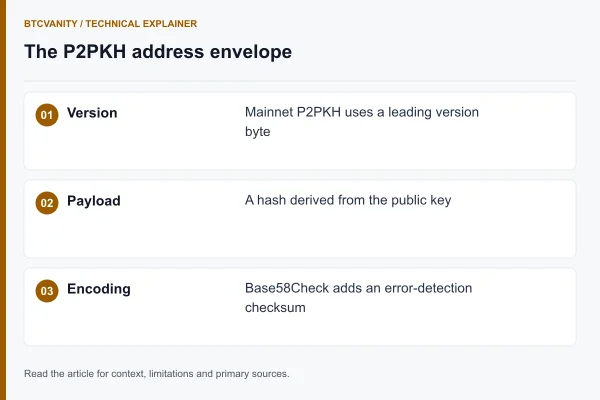
Bitcoin Vanity Address Patterns: Prefix, Suffix and Base58
Choose a valid Bitcoin vanity prefix or suffix with worked examples. Learn why P2PKH starts with 1 and why a pattern cannot turn it into bc1.
Security4 min read
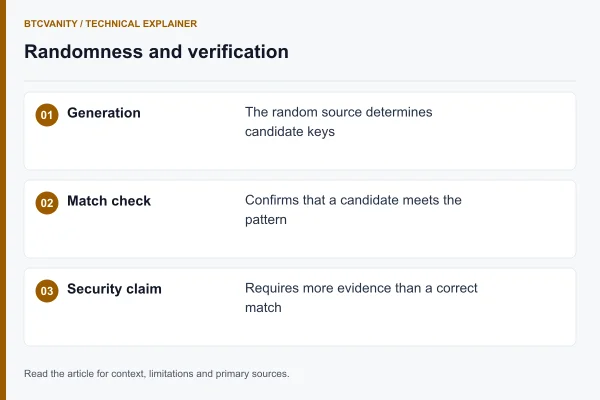
Bitcoin Vanity Generators: Local Tools, Hosted Search and Keys
Compare a local Bitcoin vanity generator with hosted search. Separate key-address validation, randomness, custody and wallet compatibility.
Keys2 min read
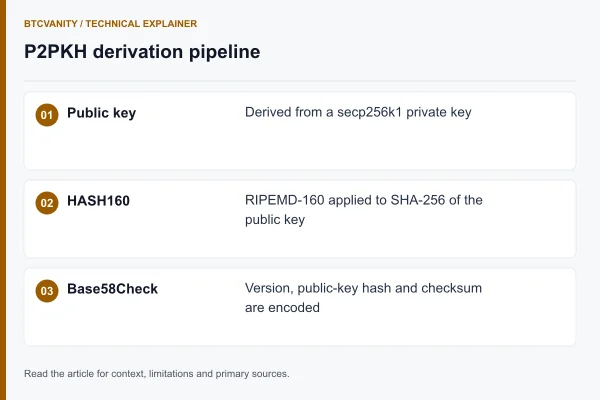
How Bitcoin P2PKH Addresses Are Derived
A Bitcoin P2PKH address is derived from a secp256k1 public key, a public-key hash, a mainnet version byte and a Base58Check encoding.
Address format2 min read
Bitcoin Address or Transaction ID: How to Tell Them Apart
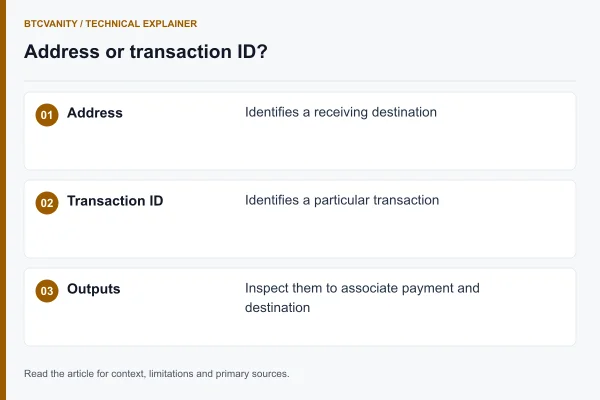
A receiving address and a transaction identifier describe different things. The result of this generator is an address and its private key, not a transaction.