
Security
Bitcoin Address Poisoning: Look-Alike Addresses
An attacker can create a different address sharing a familiar prefix or suffix. Those matching characters are not evidence of ownership.
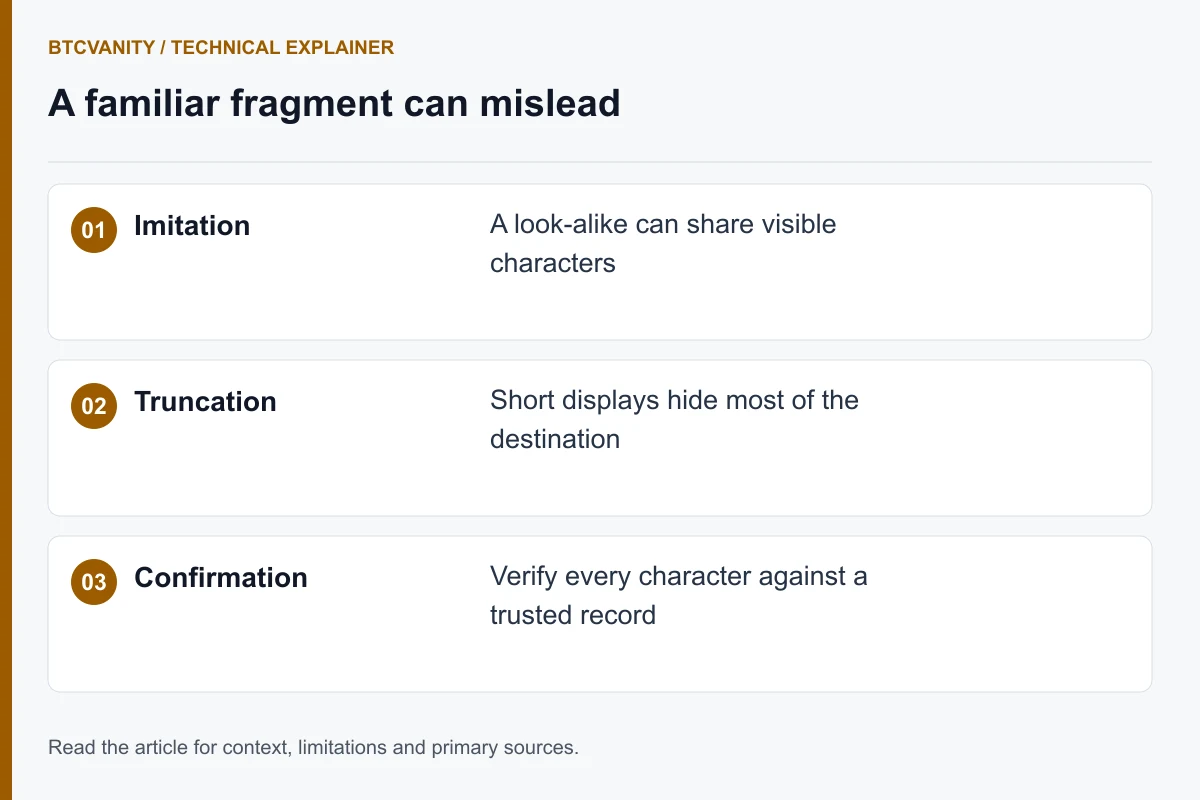
Why checking only the ends can fail
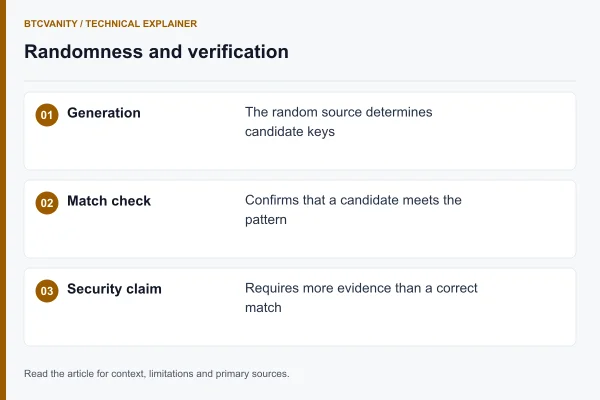
Vanity search demonstrates that a recognizable fragment is not unique evidence of a person or organization. A look-alike destination can share the characters your wallet happens to display while differing in the hidden middle.
A checksum checks the integrity of an encoded string. It does not know which recipient you intended. A malicious destination can be fully valid.
Compare against an independent reference
When preparing a payment, use receiving instructions obtained through a channel you already trust. Expand shortened addresses and compare the complete destination. If a copied value changes, or an invoice unexpectedly changes networks, resolve that discrepancy before proceeding.
- Do not choose a recipient solely from a recent-activity list.
- Inspect the address actually shown in the final wallet confirmation.
- Treat an unexpected change to established payment instructions as a reason to reconfirm them.
Publish enough information to avoid ambiguity
Display the network and complete address alongside a QR code. A memorable prefix can aid recognition, but your payment instructions should not tell users to validate only that fragment.
Read how names and vanity addresses differ if you are designing a receiving page. If an explorer result is confusing, use the address and transaction ID guide to identify the type of record you are viewing.
Explore the related mechanism
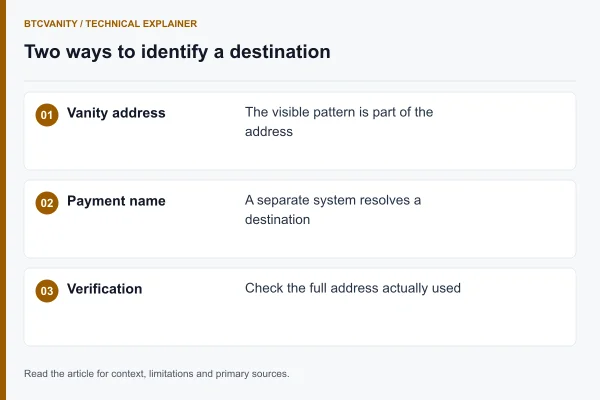
- Bitcoin Vanity Address vs Payment Name — A vanity pattern changes the address you receive; a payment name resolves or points to a destination. They are separate layers.
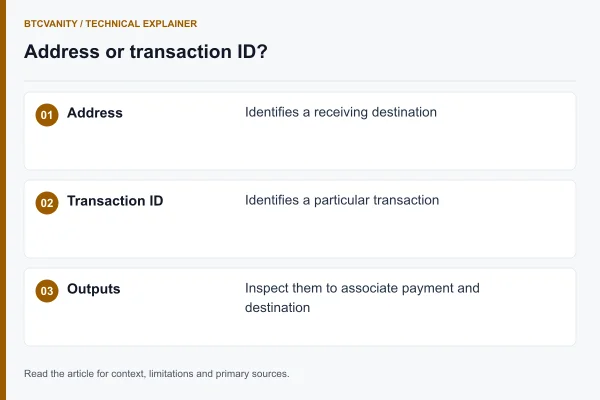
- Bitcoin Address or Transaction ID: How to Tell Them Apart — A receiving address and a transaction identifier describe different things. The result of this generator is an address and its private key, not a transaction.
- Open the complete workflow guide to place these checks in order.
- Open the address generator when you have chosen a compatible format and pattern.
Sources and editorial method
The technical references below support the concepts discussed in this article. Examples and comparison worksheets are explanatory, not measured service benchmarks.
Read next
Address format2 min read
Bitcoin Vanity Address vs Payment Name
A vanity pattern changes the address you receive; a payment name resolves or points to a destination. They are separate layers.
Address format2 min read
Bitcoin Address or Transaction ID: How to Tell Them Apart
A receiving address and a transaction identifier describe different things. The result of this generator is an address and its private key, not a transaction.
Address format3 min read
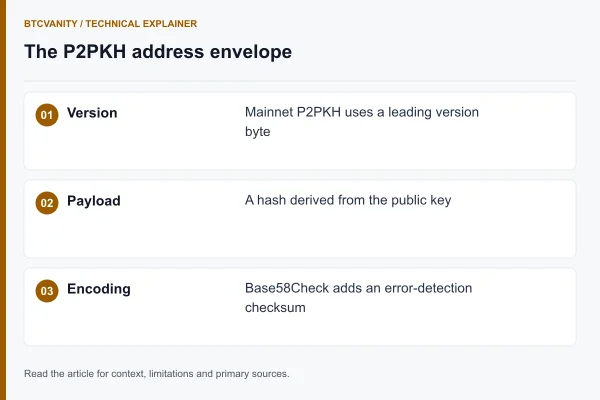
Bitcoin Vanity Address Patterns: Prefix, Suffix and Base58
Choose a valid Bitcoin vanity prefix or suffix with worked examples. Learn why P2PKH starts with 1 and why a pattern cannot turn it into bc1.
Security4 min read
Bitcoin Vanity Generators: Local Tools, Hosted Search and Keys
Compare a local Bitcoin vanity generator with hosted search. Separate key-address validation, randomness, custody and wallet compatibility.