
Transactions
Do Bitcoin Vanity Addresses Change Transaction Fees?
A recognizable pattern does not itself provide a transaction-fee discount. Fees depend on the transaction and spending conditions.
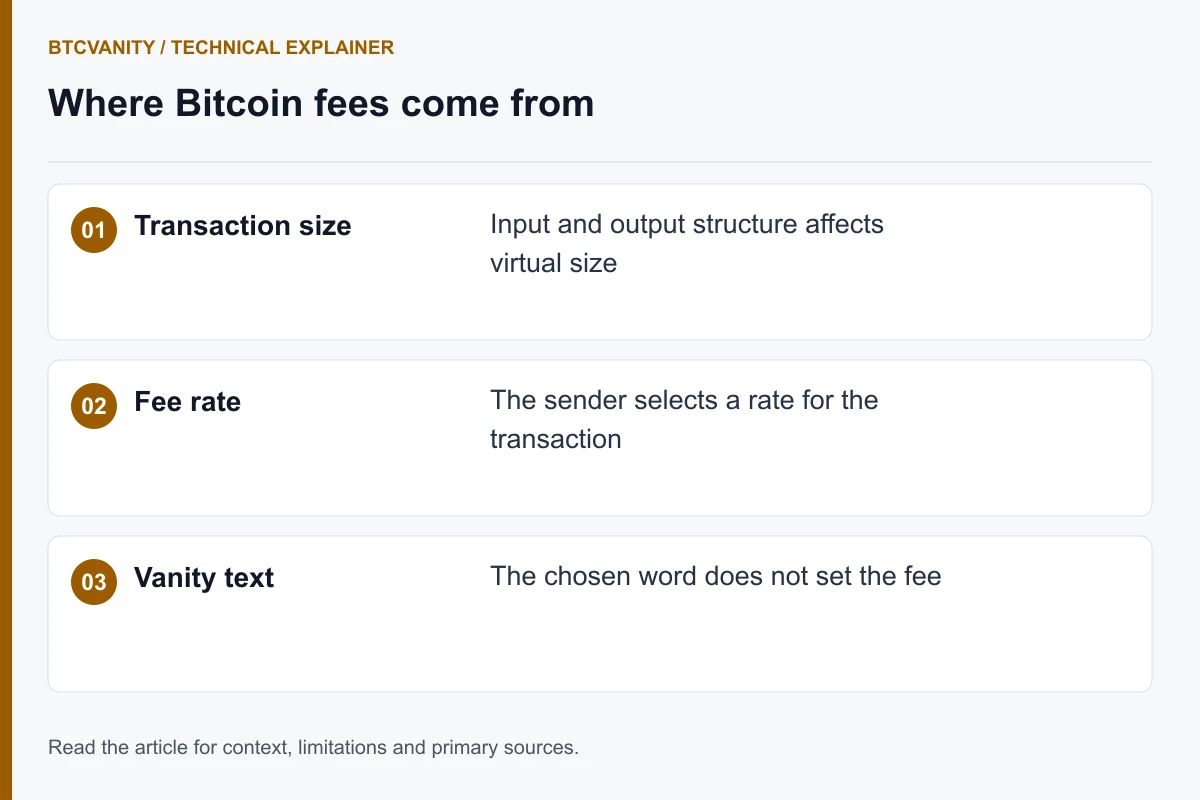
Generation and spending are separate operations
Searching for a vanity address does not create or broadcast a Bitcoin transaction. It therefore does not establish a miner fee. The generated string is a destination; a later payment is an independently constructed transaction.
A transaction fee is the difference between its input and output values. Wallets commonly express the selected rate relative to virtual transaction size. The number and type of inputs and outputs matter to that construction.
Why the visible word does not provide a discount
BTCVanity returns P2PKH addresses. Searching until one contains a preferred word does not create a cheaper P2PKH spending rule. A short-looking nickname inside the address is not a reduction in transaction data.
Comparisons between legacy, SegWit and Taproot should use the actual transaction and wallet behavior, not the attractiveness of an address. No current fee quote or savings estimate is implied by this guide.
Choose the format and payment settings independently
Read the address-format comparison before deciding that a legacy result is suitable. Use your wallet’s current transaction preview to review fees for the operation you actually intend.
If you only generated an address and expected an explorer transaction, see why a generated address is not a transaction ID. There is nothing to confirm on-chain until a transaction is submitted.
Explore the related mechanism
- Bitcoin P2PKH, SegWit and Taproot Addresses — The current worker generates legacy P2PKH addresses. It does not generate bc1 SegWit or Taproot addresses.
- Bitcoin Address or Transaction ID: How to Tell Them Apart — A receiving address and a transaction identifier describe different things. The result of this generator is an address and its private key, not a transaction.
- Open the complete workflow guide to place these checks in order.
- Open the address generator when you have chosen a compatible format and pattern.
Sources and editorial method
The technical references below support the concepts discussed in this article. Examples and comparison worksheets are explanatory, not measured service benchmarks.
Read next
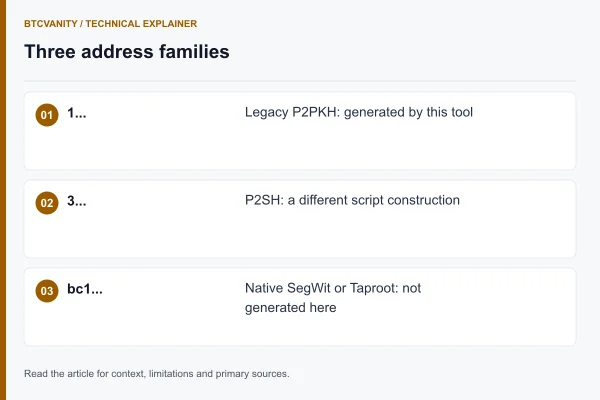
Address format2 min read
Bitcoin P2PKH, SegWit and Taproot Addresses
The current worker generates legacy P2PKH addresses. It does not generate bc1 SegWit or Taproot addresses.
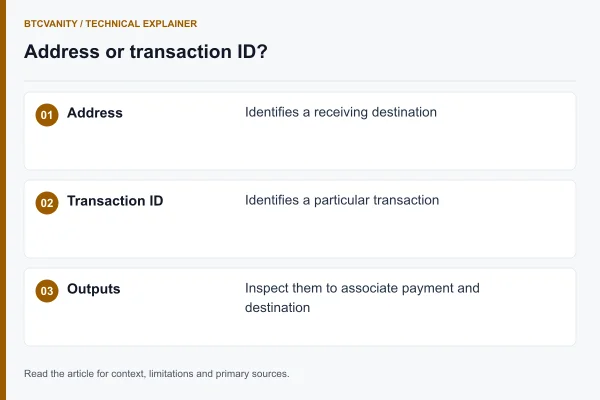
Address format2 min read
Bitcoin Address or Transaction ID: How to Tell Them Apart
A receiving address and a transaction identifier describe different things. The result of this generator is an address and its private key, not a transaction.
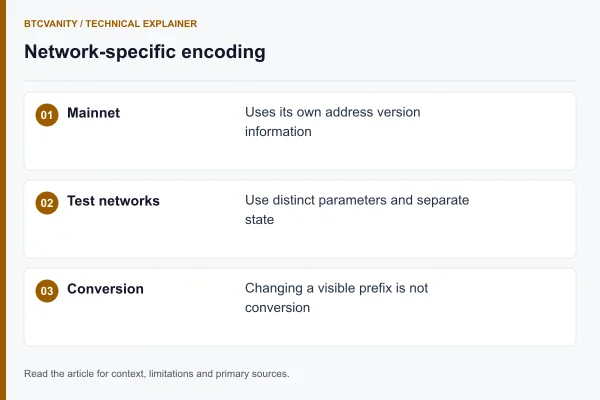
Networks2 min read
Bitcoin Mainnet and Test Networks: Keep Addresses Separate
This service generates Bitcoin mainnet P2PKH addresses. A result is not a testnet address merely because you intend to use it for testing.
Security2 min read
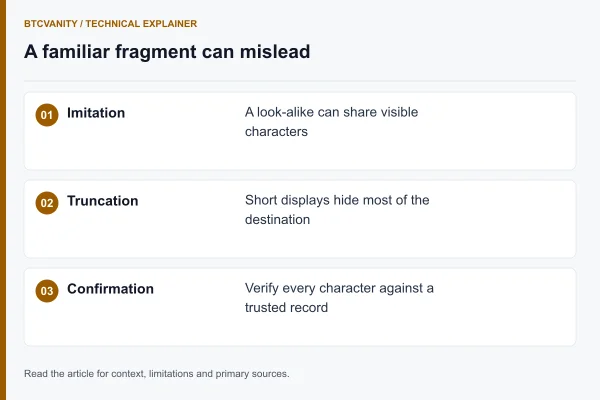
Bitcoin Address Poisoning: Look-Alike Addresses
An attacker can create a different address sharing a familiar prefix or suffix. Those matching characters are not evidence of ownership.